
Speaker: Venerable Master Chin Kung, 2022.04.11
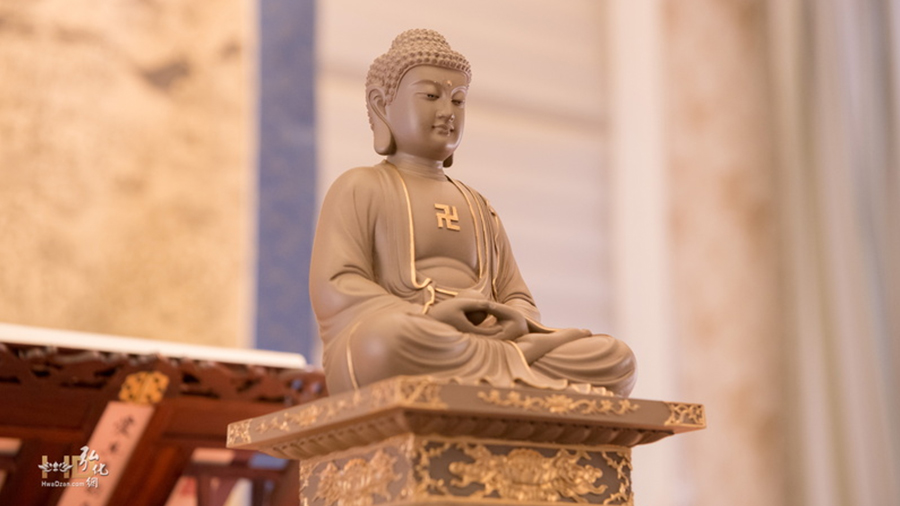
In the learning of Buddhism, what does ‘Buddha’ mean? At the start of each lecture, we take the “Three Refuges”. Its text states clearly, ‘By taking refuge in the Buddha, I am venerated as I gain the two perfections.’ What does ‘the two perfections’ refer to? It refers to having perfection in two things, namely wisdom and good fortune. A Buddha is someone who has perfect wisdom and perfect good fortune. Do we want perfect wisdom and good fortune? Why do Pureland Buddhists chant the name of Amitabha Buddha? It is to be constantly mindful of attaining perfect wisdom and good fortune. When we gain rebirth in the Pure Land, we will have attained perfect wisdom and good fortune.
Can we do without Buddha’s teachings? Well, saying ‘no’ to Buddha’s teachings is to say ‘no’ to wisdom and good fortune. Without wisdom, one is ignorant. Without good fortune, one is poor and lowly. In order to learn from Buddha, we must first clearly understand the meaning of the word ‘Buddha’. Then we will gradually understand the incredible virtue and merit of Amitabha Buddha’s name. Now, you may be able to recite the name, but there is a lack of comprehension and thus you will have doubts. When there is truly no more doubt, and we are able to recite Amitabha Buddha’s name with sincerity, respect, determination, a pure mind and confidence, the benefit we get will be incredible, just as the sutra stated before.
‘By taking refuge in the Dharma, I am venerated by being alleviated from desires.’ What is Buddhas’ teachings about? Buddha teaches us to let go. Let go of all affiliations in our mind. Why? It is to help us restore our originally pure, equal and awakened state of mind. The pure, equal and awakened state of mind is our true mind, and this mind is the Buddha mind. Every being has a Buddha mind. All beings are originally Buddhas. Buddha taught us to let go of wandering thoughts, thoughts of differentiation and attachment. By letting of these go, we are practicing Buddha dharma or Buddha’s teaching.
‘By taking refuge in the Sangha”, Sangha represents ordained monks and nuns. From the broader perspective, four people learning together is called a ‘sangha’, be they monks, nuns or lay persons. Four people cultivate together and follow the rules of Six f Harmony and Respect, i.e. harmony in having the same viewpoints, harmony in observing the same precepts, harmony in living together, harmony in speaking without conflict, harmony in experiencing Dharma bliss, harmony in sharing benefits. Any group that follows these six rules is called a harmonious group. So sangha refers to a group.
Amongst all groups, the Buddhas’ sangha is the most revered. Why? Because such a group practise the Six Harmony and Respect. It is a standard, representative and exemplary group. Being a role model, it attracts all other groups in the world to learn from them. This is what ‘Taking Refuge in the Triple Jewels’ means. A genuine Buddhist practitioner cannot do without practising the Three Learnings of precepts, meditative concentration and wisdom. Without the Three Learnings, nothing will be achieved. We must strive to do our very best to learn and practice.