
Speaker: Venerable Master Chin Kung, 2012.03.31
We have fully understood what Buddhist sutras are. This is something Buddhist practitioners must know. Buddhism is not a religion, but it has now become a religion and we cannot deny it. In my early days in the USA, I discussed this issue in lectures. Nowadays, there are six different types of Buddhism on this planet.
The first one is Sakyamuni Buddha’s teaching of Buddhism. It was a form of education, but such education is not easily found now.
The second one is that Buddhism has turned into a religion. What all of you have seen now is a religious Buddhism. Sakyamuni Buddha’s Buddhism was an education and he taught throughout his life. This is something we must know. It is clearly stated in sutras. He was ordained as monk and sought wisdom at the age of 19. He attained enlightenment at 30. He had studied for 12 years.
After attaining enlightenment, he started teaching. He delivered his first lecture to five bhikkhus at Sarnath(Deer Park). The five of them embraced what Buddha taught and requested to study under his tutelage. At 79 Sakyamuni had passed on. He had taught and lectured for 49 years. He was an educator. Using modern terms to describe him, he was neither a god nor deity but a human being.
Buddha, bodhisattva, arhat and pratyeka-buddha are all names of academic achievements or degrees in Buddhism, similar to doctorate e, Master and bachelor s degrees in the university. In ancient China we also had academic degrees, i.e. jinshi進士, juren舉人, xiucai秀才. All these are the names of academic achievements. You would study and take exams. The degree was the result of your own efforts and recognised by the public, indicating the level of your academic accomplishments.
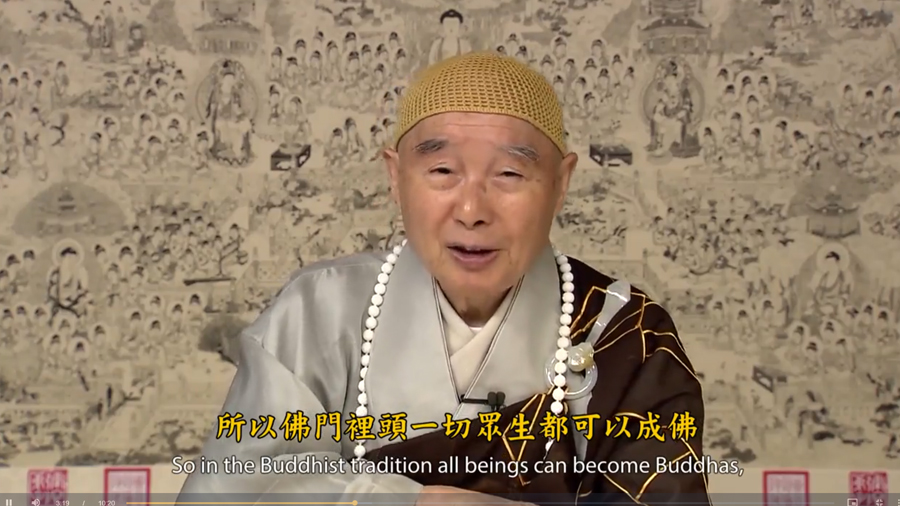
So in Buddhist tradition all beings can become Buddhas, but it is different with religion. In all religions, ,there is only one God. In Buddhist teachings, all beings can achieve Buddhahood. Buddhahood is like a doctorate degree. Everyone can get a degree. This is something we should be clear about. So when we are clear about this point with Buddhist teachings, we will not be deluded.
Buddhism has now turned into a religion. Often times, it does not teach or educate any more,and all we see are just religious rituals. Buddhist rituals are the same as religious prayers. Many people would say, ‘What you do is superstitious.’ Does prayers work? In fact, we know that it does work. Why? It is because of the power of thoughts. Scientists have discovered that the power of thoughts is incredible.
But there is a problem. We cannot provide evidence. If we say, ‘There is a disaster. Let’s pray.’ And then the disaster is resolved. People would say, ‘That’s non-sense. There is no disaster at all. You spread rumours and delude the public.’ We do not know how to respond to it. This is what it is like now. Today, the first thing that science asks is to provide evidence. That is why Buddhism must return to teaching and learning.
So what did Sakyamuni Buddha teach throughout his life? There are five aspects. The first aspect is ethics, the second aspect is morality, the third aspect is the law of cause and effect. These three aspects of his teachings are universal education which everyone should receive. When these three aspects of education are widely spread, we will enjoy social stability, happiness, peace and harmony in the society. The other two aspects are reserved for advanced studies which are not for everyone.
What are these advanced studies? One is science, the other is philosophy. Both are the pinnacles of modern science and philosophy. We can find them both in Buddhist sutras. If I am given a scientific report, I can understand it. Why? Because the findings are already recorded in Buddhist sutras. What is recorded in the sutras is more perfectly and thoroughly explained than scientific reports. My learning of Buddhism started from its philosophy.
My teacher Professor Fang Dongmei, a philosopher, told me that ‘Sakyamuni was the greatest philosopher in the world. Buddhist philosophy is the pinnacle of all philosophies in the world.’ I entered the world of Buddhism from here. I have studied it for 60 years. I realise that it is not only the pinnacle of philosophy, but also the pinnacle of science. This is the very essence of Buddhism.
Buddhism is education of science and philosophy. It is an universal education. It is something that everyone needs. It is an essential education that everyone must receive. Buddhas are called ‘the teachers of heaven and Earth’. Not only are Buddhas teachers on Earth, they are still teachers in the heaven. Buddha taught us that there is not just one heaven, but there are as many as 28 levels of heavens. Beings living in heavens have higher moral standards. So human beings who have reached that level of virtue will be reborn there.
So nowadays Buddhism has changed. It has changed into a religion. After World War II, there are a few more new types of Buddhism. One of them is enterprising Buddhism. People use entrepreneurial approach to manage Buddhism. They have headquarters and chain stores across the world. This phenomenon has occurred only after the Second World War.
Another type of Buddhism is tourism. The worst one is the ones that have turned into cults. When we learn from Buddhism, we must be clear about which type of Buddhism we are learning. I did not start from the religious Buddhism but from philosophical study. So I was not interfered by the other types and I was able to retain a relatively clear mind. That is why I can see very clearly. There are six types of Buddhism. We must learn from the genuine materials.